Description
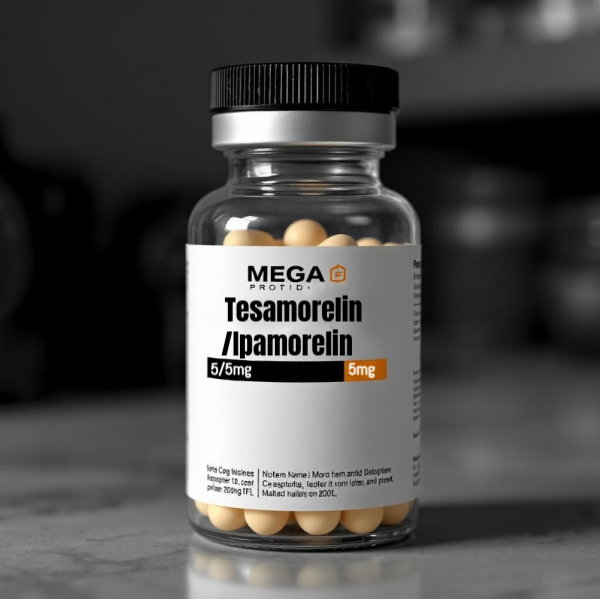
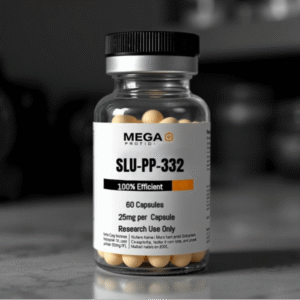
Tesamorelin + Ipamorelin: An Investigational Dual-Pathway GH–Axis Blend for Body-Composition and Metabolic Research
This investigational blend pairs tesamorelin a stabilized GHRH analog with ipamorelin, a selective ghrelin (GHSR-1a) agonist, to interrogate two complementary pituitary pathways that regulate pulsatile growth hormone (GH) release. In clinical research, tesamorelin alone has reduced visceral adipose tissue (VAT) and improved liver fat in people, while ipamorelin has been characterized as a GH-selective secretagogue with minimal ACTH/cortisol or prolactin activation compared with earlier GHRPs. Although direct randomized trials of the combined blend are not available, the GHRH+GHSR literature shows synergistic GH responses when both receptors are engaged—supporting the scientific rationale for combination research focused on body composition, ectopic fat, and metabolic biomarkers. PubMed+1 PMC Karger
Tesamorelin: Synthetic analog of human GHRH that stimulates endogenous, pulsatile GH and raises IGF-1; approved for reduction of excess VAT in HIV-associated lipodystrophy. Mechanistic and outcomes data include VAT reduction and NAFLD endpoints. FDA Access DataPubMedPMC
Ipamorelin: Pentapeptide GHSR-1a agonist designed for selective GH release with little to no ACTH/cortisol spillover in preclinical and early clinical characterization, distinguishing it from GHRP-2/-6. PubMed
Blend Rationale: Receptor complementarity. GHRH-R activation (tesamorelin) and GHSR-1a activation (ipamorelin) can potentiate GH amplitude and/or AUC versus either alone, a phenomenon repeatedly observed with GHRH + GHS co-administration in humans. Karger
Pituitary synergy: GHRH enhances somatotrope cAMP/PKA signaling; ghrelin/GHSR engages Gq/PLC/Ca²⁺ and Gi/o pathways. Convergent signaling lowers the GH-release threshold and augments pulse amplitude, explaining observed synergy in translational models. PMCPNAS
Downstream signals: Pulsatile GH elevates hepatic IGF-1, shifts lipid flux (favoring lipolysis/visceral fat mobilization), and influences glucose–lipid handling; these pathways underpin tesamorelin’s VAT and liver-fat results in clinical trials. NCBIPMC
Selectivity considerations: Ipamorelin’s GH selectivity—minimal ACTH/cortisol activation compared with older GHRPs—may allow cleaner GH-axis interrogation in combinations, though high-quality human datasets for ipamorelin remain sparse. PubMed
Plain-language interpretation of endpoints commonly evaluated in controlled studies. Not advice or usage guidance.
Visceral fat (VAT) and waist contour: Trials of tesamorelin alone demonstrate ~15–20% VAT reductions over months by CT imaging in HIV-associated central adiposity. In an individual-focused research readout, this corresponds to smaller visceral fat area on imaging and potentially improved waist contour—if the GH/IGF-1 signal is adequately engaged and sustained. (Combination studies are needed to quantify any added value from ipamorelin.) Oxford Academic
Liver fat in NAFLD (HIV context): A randomized, double-blind trial reported liver fat reduction and slower fibrosis progression signals with tesamorelin in participants with HIV and NAFLD. For an individual in research, that means lower hepatic fat fraction on MRI-PDFF and improved liver risk markers under monitored conditions. PMC
Anabolism/recovery proxies: By boosting pulsatile GH (and IGF-1), models examine lean-mass proxies, protein turnover, and functional metrics. Ghrelin-pathway activation with ipamorelin is used to amplify GH pulses without confounding stress-axis activation (cortisol), which may sharpen interpretation of anabolic signaling in research settings. PubMed
Metabolic markers: Tesamorelin studies often track lipids, CRP, and glucose indices. In individual-level research reports, favorable trends may include triglyceride lowering alongside VAT loss; however, glucose tolerance can worsen in some participants, so careful monitoring is standard in clinical protocols. PubMed FDA Access Data
Known (single-agent tesamorelin): Multiple randomized trials show VAT reduction and liver-fat improvement in specific HIV-associated populations; labeling highlights IGF-1 elevations and glucose/diabetes precautions. PubMed PMC FDA Access Data
Known (ipamorelin pharmacology): Preclinical and early human work indicates selective GH release with minimal ACTH/cortisol effects versus older GHRPs, supporting its use as a clean GHSR probe. PubMed
Known (class synergy): Human studies with GHRH + GHS show synergistic GH secretion acutely and chronically, implying that a tesamorelin–ipamorelin pairing could augment GH pulse amplitude/AUC. Karger
Unknown (the blend): No head-to-head randomized trials directly test tesamorelin + ipamorelin for VAT, lean mass, performance, or sleep outcomes; effect size, durability, and safety of the combination remain to be established. Karger
Populations: (a) Adults with excess visceral adiposity; (b) Ectopic fat phenotypes (liver fat, intramuscular fat) under specialist oversight; (c) Mechanistic physiology cohorts for GH pulsatility mapping. PMC
Core endpoints:
Imaging: VAT by CT; liver fat by MRI-PDFF.
Hormonal: GH deconvolution (pulse amplitude/frequency), IGF-1, IGFBPs.
Metabolic: Fasting lipids, OGTT/HbA1c, hs-CRP.
Function: Strength or performance proxies (exploratory). PMCNCBI
Comparators & controls: Arms with tesamorelin alone, ipamorelin alone, combination, and placebo/standard care to quantify additivity vs. synergy. Karger
Safety monitoring: IGF-1 levels, glucose tolerance, and fundoscopic surveillance as appropriate; monitor for hypersensitivity and fluid shift signals per labeling norms for GH-axis agents. FDA Access Data
Tesamorelin: Raises IGF-1 and can worsen glucose tolerance; labeling advises monitoring and discontinuation considerations when efficacy is lacking or IGF-1 remains persistently elevated. Hypersensitivity reactions are reported. FDA Access Data+1
Ipamorelin: Characterized by GH selectivity with little ACTH/cortisol release, which may reduce stress-axis confounding; comprehensive modern human safety datasets are limited, and dose/formulation choices require caution in protocols. PubMed
Magnitude & timeline: Where tesamorelin is effective, VAT changes emerge over months; any incremental benefit of adding ipamorelin (e.g., greater GH amplitude) is hypothesis-generating pending controlled trials. PubMed
External validity: Tesamorelin’s strongest evidence base is in HIV-associated lipodystrophy; the generalizability of VAT or liver-fat findings to broader populations is not established by randomized trials. PMC
Combination evidence gap: No RCTs directly test tesamorelin + ipamorelin on hard body-composition endpoints; synergy is inferred from GHRH+GHS literature and needs validation. Karger
Metabolic trade-offs: IGF-1 elevation and glucose effects require careful monitoring; risk–benefit depends on objective response (e.g., VAT reduction) versus glycemic costs. FDA Access Data
A tesamorelin–ipamorelin blend is a mechanistically coherent dual-receptor strategy to study GH pulsatility and its downstream effects on visceral adiposity, liver fat, and metabolic biomarkers. Tesamorelin provides clinically demonstrated VAT and liver-fat signals, while ipamorelin contributes GH-selective GHSR activation with minimal stress-axis engagement. The scientific premise for synergy is strong, but combination-specific, randomized human data are still needed to quantify effect size, durability, and safety relative to tesamorelin alone. PMCPubMedKarger
VAT reduction (tesamorelin, RCTs): Falutz J, et al. Effects of tesamorelin… Am J Clin Nutr/JCEM; 2010—~18% VAT reduction in HIV-associated central adiposity. PubMed
NAFLD/Liver fat (tesamorelin, RCT): Stanley TL, et al. Effects of tesamorelin on NAFLD in HIV. Lancet HIV/JAMA; 2019/2014—reduced hepatic fat and favorable liver outcomes. PMCJAMA Network
Labeling/safety (IGF-1, glucose): EGRIFTA SV Full Prescribing Information, FDA. 2025. FDA Access Data
Ipamorelin selectivity: Raun K, et al. Ipamorelin, the first selective GH secretagogue. J Endocrinol; 1998—robust GH release with no significant ACTH/cortisol rise vs GHRP-2/-6. PubMed
GHRH+GHS synergy (human data): Neuroendocrinology; combined GHRH+GHS shows synergistic GH acutely and chronically. Karger
Mechanistic crosstalk (GHRH–GHSR): Casanueva FF, et al. GHRH interacts with GHS-R1a signaling and endocytosis. PNAS/Endocrine-related papers; 2008. PMC
GH physiology & metabolic links (reference): Olarescu NC, et al. Normal Physiology of Growth Hormone in Adults. Endotext (NCBI Bookshelf); 2019. NCBI
The information provided here is for research and educational purposes only. Tesamorelin and ipamorelin—and any blend thereof—are not approved by the U.S. Food and Drug Administration (FDA) for combined use or for the diagnosis, treatment, cure, or prevention of any disease outside labeled indications. Any investigation should occur exclusively within controlled research settings, with appropriate oversight, monitoring, and compliance with all applicable laws and regulations.





Reviews
There are no reviews yet.