
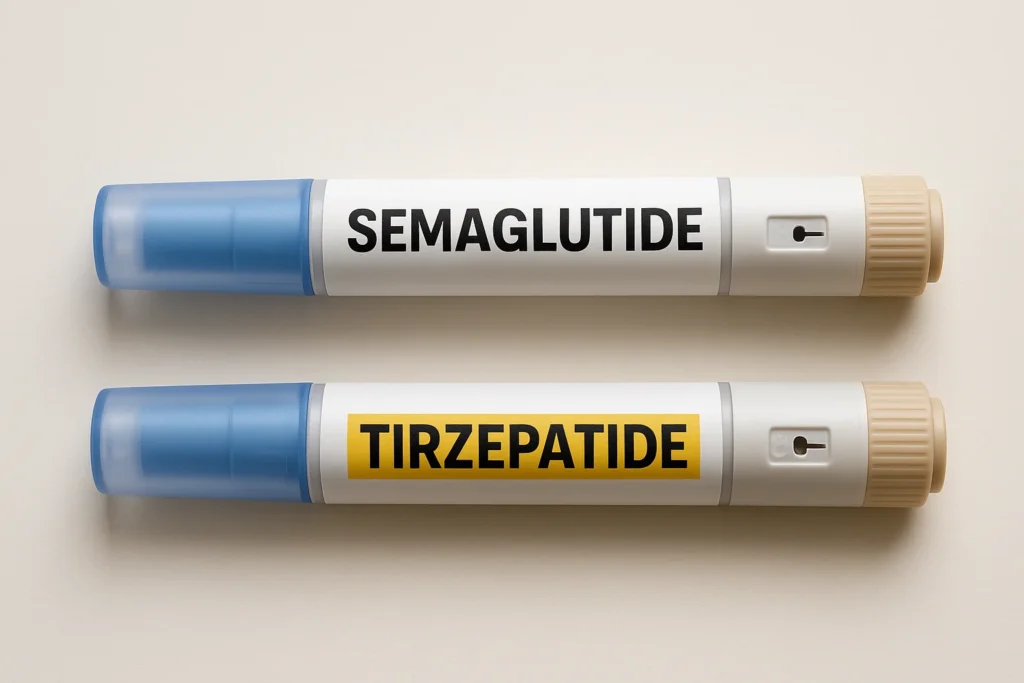
Interest in incretin-based peptides has expanded significantly in recent years, leading researchers to investigate compounds that influence metabolic signaling pathways. Two of the most discussed peptides in this category are Tirzepatide and Semaglutide.
Although both compounds interact with pathways involved in glucose regulation and appetite signaling, they are structurally different and act on different receptor targets. Understanding these distinctions is important for researchers evaluating current literature and emerging developments in peptide science.
This guide examines the mechanisms, research focus, and key differences between Tirzepatide and Semaglutide.
Semaglutide is a glucagon-like peptide-1 (GLP-1) receptor agonist. It was developed to mimic the activity of naturally occurring GLP-1, a hormone involved in glucose regulation and appetite signaling.
Researchers study GLP-1 because it plays a role in:
Semaglutide was engineered to remain active longer than endogenous GLP-1, allowing sustained receptor activity.
Tirzepatide differs from Semaglutide because it acts as a dual receptor agonist.
Researchers classify Tirzepatide as a:
GIP (glucose-dependent insulinotropic polypeptide) is another incretin hormone involved in metabolic signaling.
By targeting both GIP and GLP-1 receptors, Tirzepatide provides researchers with an opportunity to study how simultaneous receptor activation influences biological pathways.
Incretins are hormones released after food intake.
Their primary function is to help coordinate:
Two major incretin hormones include:
Produced primarily in the intestines, GLP-1 is involved in signaling processes that affect appetite and glucose regulation.
GIP is released by specialized intestinal cells and contributes to insulin-related signaling and metabolic responses.
Researchers continue investigating how these hormones interact and whether dual-target approaches provide unique biological effects.
| Feature | Tirzepatide | Semaglutide |
|---|---|---|
| Peptide Class | Dual agonist | GLP-1 agonist |
| Primary Targets | GIP + GLP-1 receptors | GLP-1 receptor |
| Research Focus | Dual incretin signaling | GLP-1 signaling |
| Mechanism Complexity | Higher | Moderate |
| Development Approach | Multi-pathway activation | Single-pathway activation |
Semaglutide primarily activates GLP-1 receptors.
Researchers study this pathway because GLP-1 signaling may influence:
GLP-1 receptors are expressed in areas associated with appetite signaling.
Research suggests GLP-1 activation influences digestive transit processes.
GLP-1 contributes to glucose-dependent insulin secretion pathways.
Researchers continue exploring how GLP-1 signaling interacts with broader metabolic systems.
Tirzepatide activates both GIP and GLP-1 receptors.
This dual-target approach has generated significant interest because it may affect multiple biological pathways simultaneously.
Researchers are studying how combined receptor activation influences:
Dual agonism may alter communication between hormonal systems involved in energy regulation.
Researchers continue evaluating how GIP and GLP-1 pathways interact when activated together.
Both receptors may contribute to appetite-related biological signaling.
The interaction between these pathways remains an active area of investigation.
The development of Tirzepatide reflects a broader trend in peptide research toward multi-target compounds.
Historically, many peptide therapies focused on a single receptor.
Researchers are increasingly exploring whether activating multiple biological pathways may produce different outcomes than single-target approaches.
This interest has contributed to growing attention around Tirzepatide within the peptide research community.
Current literature has investigated Tirzepatide and Semaglutide in relation to:
Researchers study how incretin signaling affects metabolic regulation.
These peptides are frequently used to investigate hormone-related pathways.
The relationship between incretin hormones and appetite regulation remains an active research area.
Scientists continue examining how peptide signaling contributes to maintaining energy balance.
Some researchers prefer studying compounds with highly specific targets because they allow clearer investigation of individual biological pathways.
Potential advantages include:
Semaglutide often serves as a useful model for studying GLP-1 biology.
Dual agonists offer opportunities to investigate interactions between multiple signaling systems.
Potential research advantages include:
Tirzepatide has become a prominent example of this approach.
Although interest continues to grow, researchers acknowledge several limitations.
These include:
As scientific understanding evolves, researchers continue refining knowledge of these compounds.
No. Semaglutide primarily targets GLP-1 receptors, while Tirzepatide targets both GIP and GLP-1 receptors.
Tirzepatide is generally considered more complex because it activates two receptor systems.
Researchers study dual agonism because activating multiple pathways simultaneously may provide different biological effects than targeting a single receptor.
Yes. Both are peptide-based compounds designed to interact with incretin signaling pathways.
Incretin hormones play important roles in metabolic regulation, glucose signaling, appetite pathways, and endocrine biology.
Tirzepatide and Semaglutide represent two important developments in modern peptide research. While Semaglutide focuses primarily on GLP-1 receptor activation, Tirzepatide expands the approach by targeting both GIP and GLP-1 pathways.
As interest in incretin biology continues to grow, researchers are increasingly investigating how these peptides influence metabolic signaling, endocrine function, and broader physiological processes.
Understanding the differences between Tirzepatide and Semaglutide provides valuable context for evaluating emerging research and future developments within peptide science.
Article:
What Is Retatrutide?
Article:
GLP-1 Research Peptides Guide
Anchor:
Peer-reviewed peptide research
Anchor:
Current clinical studies
Semaglutide peptide
Cagrilintide peptide


Always available!

Comes with each order!

Get access to expert resources.