

The development of incretin-based peptides continues to evolve rapidly. Among the most discussed compounds in current metabolic research are Retatrutide and Tirzepatide.
While both peptides interact with multiple hormone pathways, researchers are particularly interested in how their receptor profiles differ and what these differences may reveal about metabolic regulation.
This guide explores the key distinctions between Retatrutide and Tirzepatide, their biological targets, and the reasons they have become major areas of scientific investigation.
Tirzepatide is a dual incretin receptor agonist designed to activate:
Because it targets two important metabolic pathways simultaneously, researchers often describe Tirzepatide as a dual agonist peptide.
Current research focuses on how combined GIP and GLP-1 receptor activation influences metabolic signaling and endocrine function.
Retatrutide is considered a next-generation incretin peptide.
Unlike Tirzepatide, Retatrutide targets three receptor systems:
For this reason, researchers classify Retatrutide as a triple agonist peptide.
The addition of glucagon receptor activity has generated significant scientific interest because it introduces another metabolic pathway into the equation.
| Feature | Retatrutide | Tirzepatide |
|---|---|---|
| Peptide Class | Triple agonist | Dual agonist |
| GLP-1 Activity | Yes | Yes |
| GIP Activity | Yes | Yes |
| Glucagon Activity | Yes | No |
| Mechanism Complexity | Higher | Moderate |
| Research Focus | Three pathways | Two pathways |
The biggest distinction between these peptides is receptor activity.
Activates:
Activates:
This additional receptor target makes Retatrutide one of the most complex metabolic peptides currently under investigation.
Researchers frequently compare these compounds because they represent different generations of peptide engineering.
Second-generation dual agonist.
Third-generation triple agonist.
The goal of triple agonism is to investigate whether activating multiple biological systems simultaneously can produce unique physiological effects.
Retatrutide includes glucagon receptor activation.
Researchers study glucagon because it influences:
Tirzepatide does not directly target glucagon receptors.
This distinction is one of the primary reasons Retatrutide has attracted attention within peptide research.
Retatrutide introduces an additional biological variable.
Scientists studying triple agonist compounds must evaluate interactions among:
Tirzepatide involves two pathways, making its mechanism somewhat easier to analyze.
Retatrutide represents one of the newest developments in incretin peptide science.
Researchers continue investigating:
As a result, Retatrutide has become a major topic within current peptide literature.
One area of interest involves receptor synergy.
Researchers are evaluating whether activating three receptor systems simultaneously may create different biological responses than dual agonist approaches.
This remains an active area of investigation.
Acts through:
Acts through:
The inclusion of glucagon signaling creates a broader mechanism profile.
Many scientists view triple agonist peptides as a potential next step in peptide development.
Research continues examining:
Retatrutide is often highlighted as an example of this emerging direction.
Researchers often view the progression as:
This framework helps explain why Retatrutide is frequently discussed alongside Tirzepatide.
Both peptides occupy an important position within modern incretin research.
Scientists compare them because they offer insight into:
Understanding these distinctions helps researchers evaluate emerging developments within the field.
Suggested internal links:
Suggested DoFollow references:
No. Tirzepatide targets GIP and GLP-1 receptors, while Retatrutide targets GIP, GLP-1, and glucagon receptors.
Because it activates three receptor systems rather than two.
Glucagon plays an important role in metabolic signaling and energy regulation, making it a valuable area of study.
Retatrutide generally has the more complex mechanism because it involves three receptor pathways.
Researchers are studying whether multi-pathway activation can provide new insights into metabolic biology and peptide development.
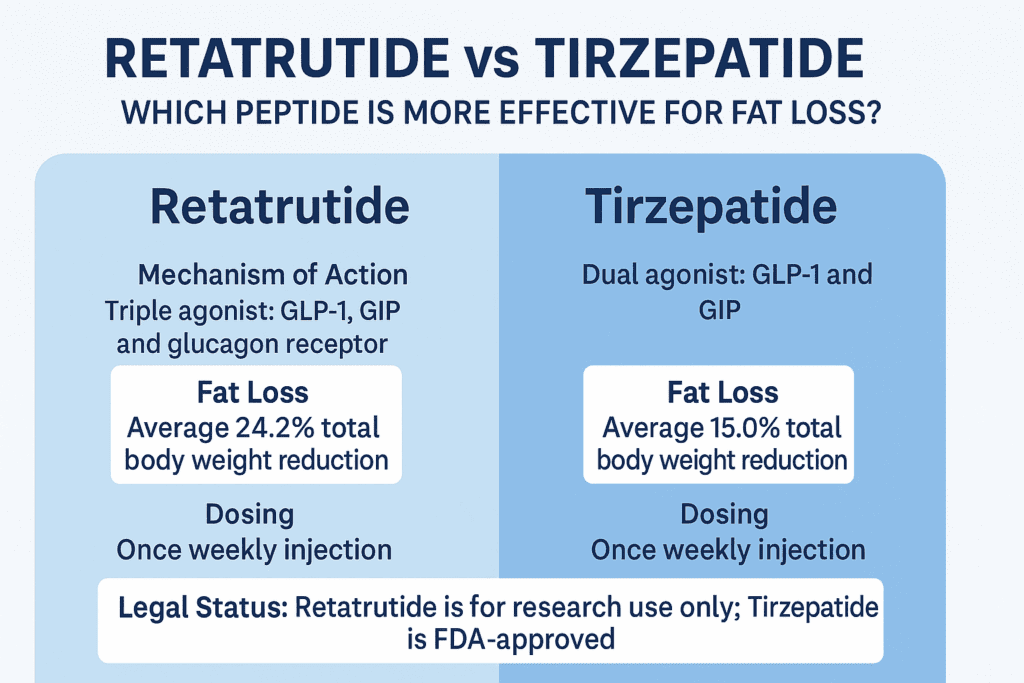


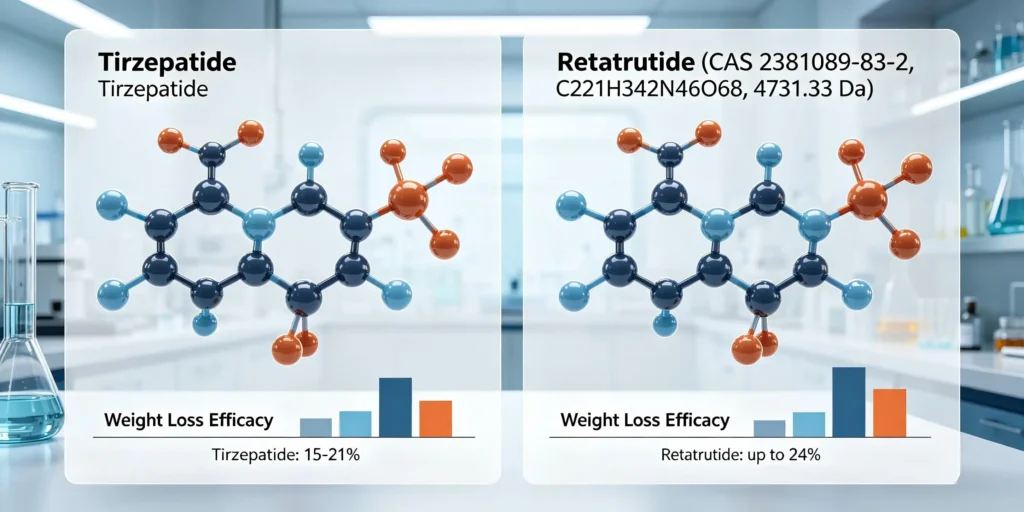
Image File:
retatrutide-vs-tirzepatide-comparison.jpg
Alt Text:
Retatrutide vs Tirzepatide
Additional Image:
triple-agonist-vs-dual-agonist.jpg
Alt Text:
Retatrutide triple agonist compared with Tirzepatide dual agonist
Video Embed Suggestion:
Understanding Triple Agonist Peptides and Metabolic Signaling

Always available!

Comes with each order!

Get access to expert resources.