
The comparison of Cagrilintide vs Semaglutide has become increasingly important as researchers investigate different pathways involved in metabolic signaling. While both peptides are studied within the broader field of metabolic research, they work through distinct biological mechanisms.
Understanding the differences between Cagrilintide vs Semaglutide helps researchers evaluate how amylin-based peptides and GLP-1 receptor agonists may influence physiological processes.
When discussing Cagrilintide vs Semaglutide, it is important to understand that these compounds belong to different peptide classes.
Cagrilintide is a long-acting amylin analogue designed to mimic the activity of the naturally occurring hormone amylin.
Researchers study amylin because it is involved in:
Semaglutide is a GLP-1 receptor agonist that mimics glucagon-like peptide-1 signaling pathways.
Research involving Semaglutide often focuses on:
| Feature | Cagrilintide | Semaglutide |
|---|---|---|
| Peptide Class | Amylin analogue | GLP-1 agonist |
| Primary Target | Amylin receptors | GLP-1 receptors |
| Hormonal Pathway | Amylin signaling | GLP-1 signaling |
| Research Area | Metabolic biology | Metabolic biology |
| Mechanism Type | Amylin-based | Incretin-based |
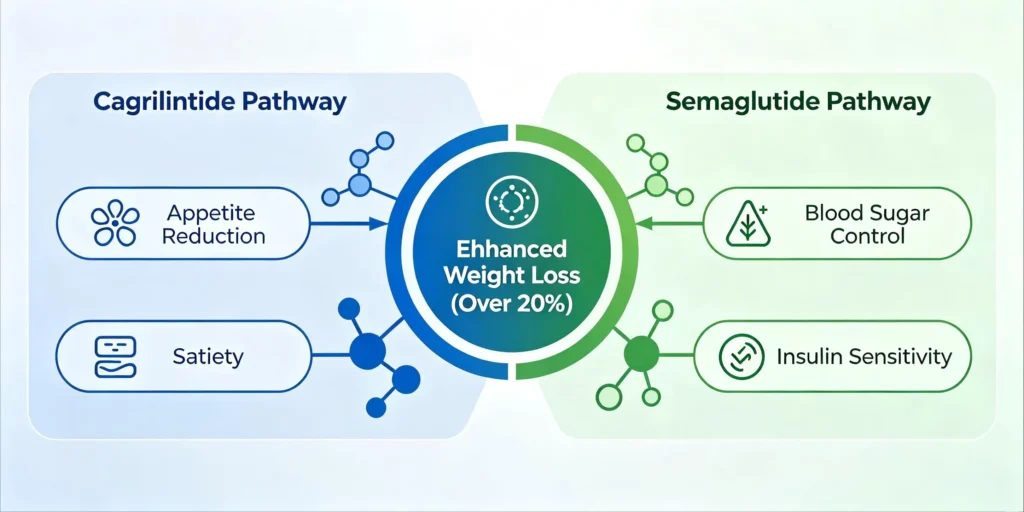
The biggest distinction in Cagrilintide vs Semaglutide research is receptor activity.
Cagrilintide primarily targets pathways associated with amylin signaling.
Semaglutide primarily activates GLP-1 receptors.
Because these pathways are different, researchers often compare them to understand how various hormonal systems interact.
Amylin and GLP-1 are separate hormones.
Designed to mimic amylin activity.
Designed to mimic GLP-1 activity.
This distinction is central to understanding Cagrilintide vs Semaglutide.
Researchers continue studying the biological effects associated with each pathway.
Research focuses on:
Research focuses on:
The growing interest in Cagrilintide vs Semaglutide stems from a broader effort to understand metabolic regulation.
Researchers investigate:
One reason Cagrilintide vs Semaglutide receives attention is that scientists have explored how amylin and GLP-1 pathways may complement one another.
This area remains an active field of investigation.
Cagrilintide and Semaglutide were engineered for different receptor systems.
Researchers study these compounds to better understand:
Both compounds continue to generate scientific interest.
Future investigations may provide additional insight into:
Related Products:
ClinicalTrials.gov
National Center for Biotechnology Information (NCBI)
No. Cagrilintide is an amylin analogue, while Semaglutide is a GLP-1 receptor agonist.
Researchers study different hormonal pathways involved in metabolic regulation and endocrine signaling.
Cagrilintide is designed to mimic amylin-related signaling pathways.
Semaglutide primarily activates GLP-1 receptors.
Researchers investigate metabolic peptides to better understand hormonal communication and physiological regulation.

Always available!

Comes with each order!

Get access to expert resources.